Got home late from work, and instead of cooking we ordered Chinese. One of my favorite parts of moving is finding new take out places, and I've been lucky enough to find a great (if not pricey)
place that delivers Szechaun food. The best part of the menu is that it's full of offal - delicious offal prepared in ways I would never prepare it myself.

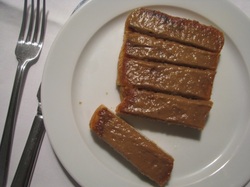
The best part of dinner.
The beef tendon was tender and gelatinous, thinly sliced and floating in chili oil with sesame seeds and scallions. The gelatinous tendon and the aggressive spice worked together, and even played off one another in the kind of way that makes me want to cook tendon. Truthfully, the thought of cooking tendon has always intimidated me.
It's awesome to find a delivery place that inspires me to buy more offal.
Suet is raw beef fat found around the kidneys and loins, tallow is what you have after you melt it, and strain it.
After my last adventure
rendering lard, being stuck in the kitchen for six hours watching fat melt I was prepared for the long haul. But surprisingly, tallow was much more forgiving than lard.

Suet.
First you chop the suet into smallish pieces.
Put your chopped suet into a thick bottomed pot, over a low heat and prepare for the waiting game to begin.
Or not.
My suet took half the time to melt than my pig fat did - which was a nice surprise.

After about an hour, maybe a tad longer.
The tallow that I'm making is destined for french fries, beef fat makes really great fries. It's also shelf stable if kept in an airtight container.

At the three hour mark.
Much like lard my next steps are strain out the hard bits that have sunk to the bottom. Many recipes suggest that after you strain you heat again.

Strained, hot tallow.
That's it - in three hours (not six) I have beautiful yellow tallow that will sit in the fridge and turn a lovely crisp white colour once it has chilled.

Chilled tallow.
Now off to make some fries, or candles.
Here she is, in all her gelatinous glory.
The texture of the feet is lovely, a little firm but definitely supple. I wish I would have included some more meat, maybe some chopped up ham.
I'm proud to say my gelatin is definitely stable at room temperature - no leaky feet here.
Having been repeatedly told that one of the biggest barriers to enjoying headcheese is the word headcheese I've decided to make a very similar dish (meat set in gelatin) but use a few different ingredients and call it something a tad more pleasing to the ear - pain de pieds was born.
Playing off of headcheese, I decided on feetbread (I used trotters as my gelatin source.) That name, however, did not sound any more appetizing than headcheese. A light bulb went off, I translated it into french and a much more pleasing (at least in name) dish was born.

Trotters and dried spices soming up to a simmer.
My chopped up trotters (pigs feet) went into a pot of cold water with some dried whole spices; juniper, peppercorns, allspice and whole dried chili.
This pot was on the stove, being occasionally filled up from my kettle, for a few hours. When cooking trotters always skim the foam that appears on the top of the pot. There will be lots of foam.
When the trotters are lovely and tender strain the trotters and keep the liquid. It will be cloudy and full of gelatin (awesome).

Feet and cooking liquid.
When the trotters are cool enough to handle carefully pick all the meat, skin and tendon from the bones. Make very sure you remove all the bones.

Bones on the left, good stuff on the right.
Take all the meat, skin etc that you've lovingly separated from the bones and chop it finely.
Put your pile of meaty skin, and gelatinous stock in the fridge and let the stock set.
Once set its texture should look like this.
Yum.
Taste your trotter jello - it should taste savory but not too complex. Keep in mind that this will be served cold, so go a little heavy on the seasoning.
Put your jello in a pot to melt. I seasoned mine with salt, siracha, white wine and cider vinegar. I also chopped up the only carrot in my house (which is kinda sad) in a fine brunoise and put it in my simmering stock to cook very slightly.
Line a small, loaf shaped dish with plastic and put your chopped feet in the bottom. Strain the carrots, pour your seasoned liquid over the chopped feet and sprinkle the carrot over the liquid.
Put the whole mess back in the fridge to set, ideally overnight.
I'm too excited to be back, I just couldn't wait to post. I don't have a finished image yet, tomorrow, I promise.
Also - I wanted to say "Hi!" and thanks for stopping by Formaggio yesterday to the nice man from Michigan. I was in the shop later that day, and was really sorry I missed you!
More on my pain de pieds tomorrow.
I bought a house - and we're moving this month. Having time to cook (and even eat) has become a luxury, fingers crossed I'll get a post up this week.
Braised lamb shanks are a favorite comfort food of mine. A well cooked shank is tender and succulent, never tough or dry. Normally when braising I reach for my dried mushrooms and a bottle of red wine, this time I thought I'd try something different.

Lamb shanks.
I had one kinda sad looking eggplant in my fridge, and some fenugreek in my spice cabinet. Eggplant as not something I really wanted to braise, so I gave them a good coating of salt and let them drain, hoping to remove some of the bitterness that's present in eggplants.
Braising a lamb shank is like braising anything else. Give it a good sear followed by some solid cooking liquid and you're guaranteed favorable results.
I seared the shanks, then added some diced onion and cloves of garlic to the pan. Always remember to scrape up the leftover bits of meat after searing. That's the good stuff.
The braising liquid I used was stock, seasoned with fenugreek, black pepper, cinnamon and cayenne. The liquid goes over the shanks and onion/garlic mix, then in the oven at 325 degrees for an hour or two.

After 2 hours in the oven.
When the shanks are fork tender I removed them, then strained and reduced the cooking liquid. By this time the eggplant were looking wilted and wet from the salt - I dried them with paper towel and seared in them in olive oil until golden.
When the cooking liquid looked thick enough the shanks went back in to warm up. Then it was dinner. Lamb shanks on top of rice with toasted almonds. My sauteed eggplant ended up being more of a garnish on top - but were nice and crisp with a little sweetness.

Bones worth sucking on.
My favorite part of lamb shanks is once you've finished the meat, the bones still have little gelatinous bits of tendon clinging to them. Knives and forks don't really work, so you just need to pick it up and knaw on it. Lamb shanks always make me feel like a seriously classy caveman.
My recent post about
eating shrimp tails seemed to get some good response, so I thought I'd do about post about eating whole shrimp. Once again, for breakfast. Congee is a rice porridge, flavoured with fish sauce and soy sauce, and whatever else you have on hand. It's a terrific breakfast dish for those of us who want the comfort of porridge, but don't really dig sweet in the morning.
The last time
I made congee I did not have any dried shrimp. This time, thanks to my dear friend
Jo at
Create A Cook, I have some lovely whole dried shrimp in Korean chili oil that are going to be perfect for my little pot of congee. When I say whole I mean shells, eyes, little flipper things - the entire creature. These shrimp are a tad larger than the dried shrimp I've used in the past, so I'm excited to see what kind of texture they are going to add to my dish.

My new ingredient.
The
basic recipe I use is by
David Lebovitz - it's a terrific recipe that you can really make your own. In my opinion congee (or Jook as it's sometimes called) does not keep very well. For one person I use a quarter cup of rice and a half cup of water. Although, I add a fair bit of water during the cooking process to give it the right porridgy consistency.
I add my minced ginger and garlic as soon as the rice/water mixture starts to simmer. The other ingredients are based on what I have on hand, and added when the rice has begun to get soft. Some diced carrot, frozen peas, a pinch of salt and once the rice is tender I add a little dash of fish sauce and soy sauce as well as my dried shrimp.

Shrimp, ginger, peas and carrot.
The chili oil that the shrimp were packaged in gave my congee a little heat which added a surprising element to the congee. I don't normally add any chili's but after this experience they are going to become a regular player.
The whole shrimp added body (literally) and texture to the congee. And although they were larger than the dried shrimp I had used previously they still managed to add to the dish without taking away from any of the other flavours or textures.

Breakfast.
I think this is possibly the best congee I've ever made. The flavours are all working together, nothing it too overpowering and it's warm and soothing on the tongue.

Last bite.
I'm ready to face my day, even if I'm wishing I'd made enough for a second bowl.
Due to my Canadian childhood I had little to no experience with Mexican food until I moved to the US. And when I did move I went a little burrito crazy - as in all things wrapped in a large tortilla were good. There was no filter. None.
Having lived in America for the past three years I've gotten a little better with Mexican food in general - but I'm still trying to tune my burrito filter. They all still taste pretty flippin' good to me.
My favorite burrito served at the
Mexican place down the street from my house is the beef tongue (or lengua). I decided to treat myself earlier today.

My lunch, in all its foil-wrapped glory.
I love this filling. Tongue seems somehow beefier and more substantial than the regular beef. And my little place goes the extra mile and grills the tongue so it gets a crisp almost charred taste and texture. Combined with the soft rice, gooey beans and fresh iceberg lettuce my tongue was very happy to have another tongue as it's companion for lunch.

The first few bites.
Combine this with a little homemade hot sauce thats got the ideal amount of heat (not too much - I'm a bit of a wuss) and I am one happy Canadian.
Tongue is not only a great economy food (there's a lot of food in one tongue) but as I've demonstrated in other posts (
salad,
sandwich and
main course) it's very versatile.
I may not know much about Mexican food, but I know a little about tongue, and I sincerely advise everyone to go try a tongue burrito for lunch soon. Your tongue will welcome the company.
Sadly, I got no pictures.
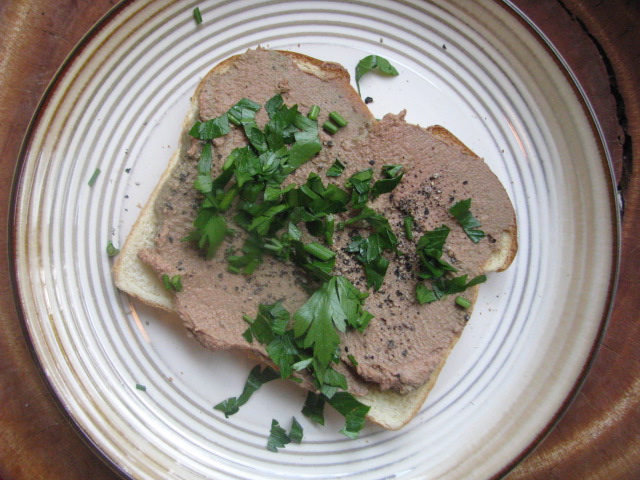
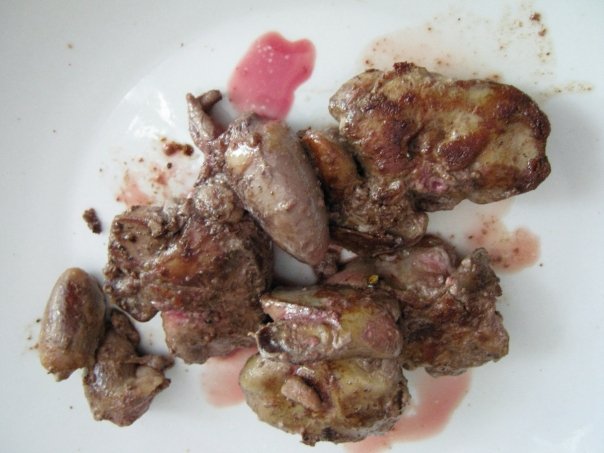
The non-vegetarian main was galantines of Cornish hen. The hens all came with their little packets of giblets most of which went into the stock pot. I did however save the livers and soak them in port overnight. A quick sear in butter and onto a crostini -the sauce got finished with cream and drizzled over my port soaked liver crostini.
Only three of us ate them, but I have to admit they were really tasty.
One of my New Years Eve companions did get a picture of a gallantine. I stole this off facebook

Galantine of Cornish hen stuffed with cornbread, sausage and leek.
I'm very happy with how I managed to sneak in a little nose to tail into my New Years Eve - I'm really looking forward to another year of these tasty treats!
Wishing everyone a great holiday!
Be back in the New Year.